Hi! I’m Annie, your friendly biologist and Hinterland Who’s Who Coordinator.
In honour of this National Day for Truth and Reconciliation, I would like to highlight the profound impact of First Nations, Inuit and Métis on the Hinterland Who’s Who program.
I’ve always been drawn to Indigenous languages, cultures and knowledge. I had the chance, when I was a teenager, to live in an Anishinaabe community for a while. We had an Elder come to my school regularly to teach us Indigenous learnings. Since then, I’ve been listening to what Indigenous people have to say about nature and wildlife. I had the pleasure of working alongside Indigenous people on a few different projects, and I’ve learned so much! For me, to include this knowledge in my work was a given.
Adapting HWW to Indigenous Languages
We wanted to create Indigenous language versions of some of our materials that had significant Indigenous cultural and scientific relevance.
Folks would then be able to learn about a few species in their own language. Through this process, we also wanted to showcase languages from different parts of Canada. This could seem, at first, like a pretty straightforward endeavour — until you learn that there are about 70 Indigenous languages spoken in Canada today.
We needed help to figure out what to do. Talking with Indigenous specialists, sociologists and geographers, we were able to make choices. While some languages are spoken by more people, it became more interesting to focus on languages that were understandable to most people, what languages were the most mutually intelligible. It’s a slight difference, but an important one.
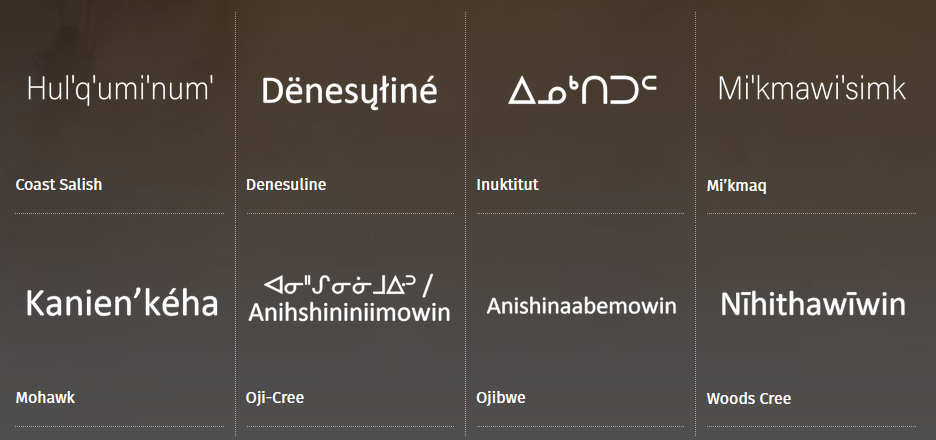
For example, Cree — an Algonquian language — is the most spoken Indigenous language in Canada. But there are 11 dialects of Cree and so we had a look to see what was easiest to understand. We landed on Woods Cree, or Nīhithawīwin. Same thing for Inuktitut: the easiest dialect to understand for most Inuit is the one spoken in Iqaluit since most media originate from there.
On the West Coast, the difficulty went up a notch. Since many communities were isolated from one another, they developed 14 different languages of the Coast Salish, which are often not mutually intelligible. We then chose the one with the most speakers — Island Halkomelem, or Hulʼqumiʼnum.
This is how we ended up with Kanienʼkéha (Mohawk language), Mi’kmawi’simk (Mi’kmaq language), ᐃᓄᒃᑎᑐᑦ (Inuktitut), Dënesųłinë́ (Dene language), ᐊᓂᐦᔑᓂᓃᒧᐏᐣ / Anishininiimowin (Oji-Cree language), Anishinaabemowin (Ojibwe language), Hulʼqumiʼnum (Coast Salish language or Island Halkomelem) and Nīhithawīwin (Woods Cree language) to showcase freshwater turtles, the American Raven, the wolf and the wolverine. It was also decided to translate and dub the HWW videos rather than adding sub-titles since the languages are more oral-based, and many people might not be as familiar with the written word. Finding translators and speakers was also not easy, but we were successful, in the end!
Embedding Indigenous Culture and Knowledge
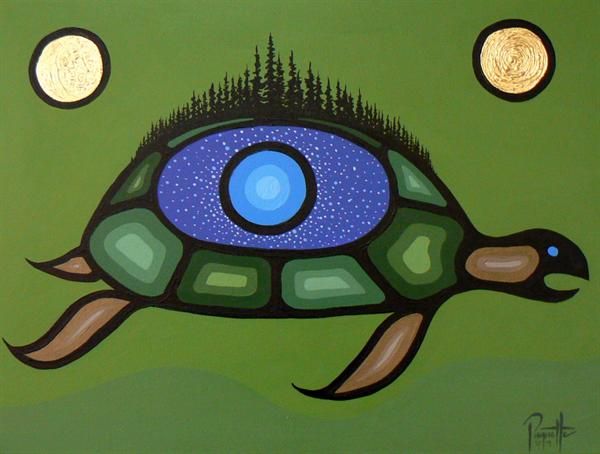
Another aspect of this process was to include references to Indigenous culture and knowledge within the script of the HWW videos and the text of the fact sheets. Since Métis, First Nations and Inuit were the first stewards of this land, they have millennia of experience observing wildlife, while Settlers only have a few hundred years. Their knowledge gives better understanding of some species for which scientists may lack data. For example, biologists didn’t know where exactly Narwhals were heading during the winter… but guess what? The Inuit did! Why? Because they have relied on this species for survival since times immemorial. When they shared this knowledge with scientists, a conundrum was solved!
The connection between Indigenous Peoples and wildlife is also highlighted in their culture. A species may be part of tradition, spirituality or lifestyle (as an important source of clothing, for example). At HWW, we have tried, and will continue trying, to include some of this information in our fact sheets and materials. It has been a pleasure to interview different members of various communities to that effect, and to talk about what impact these species have.
Reconciliation may happen in many forms… At HWW, we honour the connection between wildlife species and Indigenous Peoples. We hope you will too!

Annie Langlois
An avid fan of wildlife education programs, including Hinterland Who’s Who, ever since she was a child, Annie Langlois became a biologist, completing her Master’s on the Harlequin Duck in 2006. After working in Species at Risk recovery policy for a little while, she has devoted her career to giving back by helping the general public better understand our natural heritage. She has managed the Hinterland Who’s Who program since 2010.