Nobody likes going to the clinic for a checkup.
How’s my cholesterol? Did I gain too much weight? What IS this spot on my skin?
But for North Atlantic Right Whales, they can get a checkup without even knowing it’s happening.
Research published in the fall 2025 edition of the journal International Society for Microbial Ecology showed that scientists can monitor the health of these behemoths through taking non-invasive breath samples on drone-flown petri dishes.
In an interview with CBC, Sean Brillant, CWF’s senior conservation biologist for marine programs, is quoted as saying that the study is “surprising and a really novel approach.” He added that whales that suffer ill effects from entanglements or ship strikes should benefit from researchers monitoring their health from the spray from their blowholes. whales that suffer ill effects from entanglements or ship strikes should benefit from researchers monitoring their health from the spray from their blowholes.
How Does It Work?
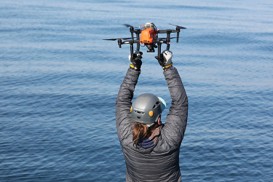
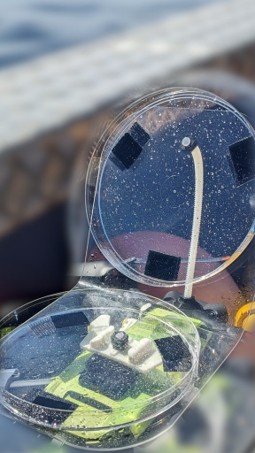
Since 2016, Woods Hole Oceanographic Institution (WHOI) in the U.S. have taken 103 samples from marine animals — 85 of which were North Atlantic Right Whales. When a whale was spotted, they attached a large petri dish to the bottom of a drone and hovered over the animal to catch the spray from their blowhole as it exhaled.
The drone was then flown back to the researcher on a nearby vessel and the samples were immediately taken for analysis. Bacteria from the spray droplets were analyzed, which helped determine among other things the animal’s robustness, thinness, length, skin condition and presence of whale lice.
“This is a major step forward in developing new approaches for monitoring wildlife health,” Carolyn Miller, a large whale biologist at WHOI and a lead author of the study said in an interview for Earth.com. She then states that it is a safer, less invasive method — the whales likely never knew the drone was there at all.
Other Tech Employed to Help Whales
Utilizing tech to help whales is not new in marine conservation. In fact, the Canadian Wildlife Federation has been using technology to help conserve these at-risk animals for years — and the research we’ve been gathering has been instrumental to helping them.
- Read about the new tool we helped develop to predict impact of vessel strikes
- Learn about our vessel strike research in the Gulf of St. Lawrence
Here are a few more tools of the trade CWF has employed to help conserve marine mammals.
On-demand Fishing Gear
One of the measures implemented by Fisheries and Oceans Canada to mitigate entanglement are time-area fishery closures. Time-area closures are activated when a North Atlantic Right Whale is detected, and no traditional fishing gear is allowed in a defined area around the detected whale in order to reduce the risk of entanglement in ropes.
In response, CWF has been trialing rope-on-demand fishing gear which may provide harvesters with the opportunity to continue fishing operations in the presence of North Atlantic Right Whales and provide whales the opportunity to swim and feed with reduced chances of entanglement.
Also referred to as ‘ropeless’ or ‘pop-up gear’, on-demand fishing gear is an innovative technology that removes the persistent buoyline from the water column by keeping the buoyline at the seafloor. When a harvester is ready to haul their gear and collect their catch, an acoustic signal triggers the on-demand fishing gear system to release the buoyline, where the harvester can retrieve their gear as normal. As there aren’t persistent buoylines, on-demand fishing gear may allow trained harvesters to fish in areas closed to traditional gear with buoylines to help conserve North Atlantic Right Whales.
Learn more at CanFishGear.ca.

Tobi McIntyre
Tobi is the Interactive Content Manager for the Canadian Wildlife Federation. With training in biogeography, paleoanthropology and journalism, Tobi is happiest being outside feeling the sun, wind and soil on her skin. She has a deep respect for wildlife and enjoys sharing this awareness with her son and anyone else who'll listen.