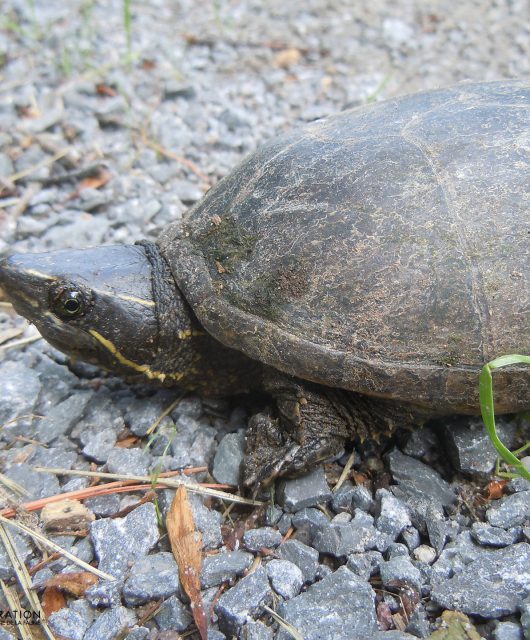
While looking at the photos in 2021 for a paper on threats to Northern Map Turtles, we stumbled on an observation where the turtle just looked…off.
It looked very similar to the Northern Map Turtle but there were enough discrepancies that we flagged it as something to investigate and moved on. We later realized that this was one of the first observations of the non-native False Map Turtle in Canada. The False Map Turtle is native to the Missouri and Mississippi river systems of the U.S.. Five years later there are now more than 100 observations in Canada. Furthermore, the Ouachita Map Turtle, another invader from the south, now has more than 20 observations on iNaturalist in Canada. To date, the non-native map turtles have been observed in British Columbia, Ontario and Quebec.
We’ve covered the issues of non-native turtles before, but how do we differentiate between the three species of map turtles – the native Northern Map Turtle and the non-native False Map Turtle and Ouachita Map Turtle? Why is this important? I mentioned at the beginning that we were initially confused by a photo of a False Map Turtle posted to iNaturalist, because it was misidentified as a Northern Map Turtle. Unfortunately tracking non-native species is hard to do unless they are correctly identified.
How do you tell the difference between these three species of turtles?
This is a bit of a difficult process as it requires a very clear photo of the turtle’s head in profile, detailing the patterning.
Northern Map Turtle
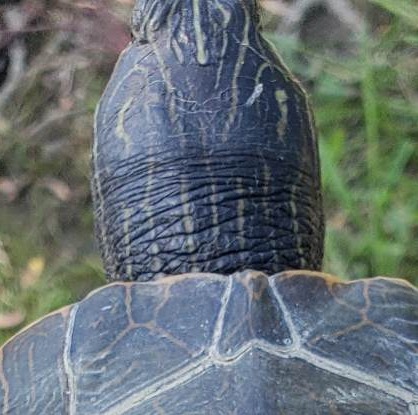
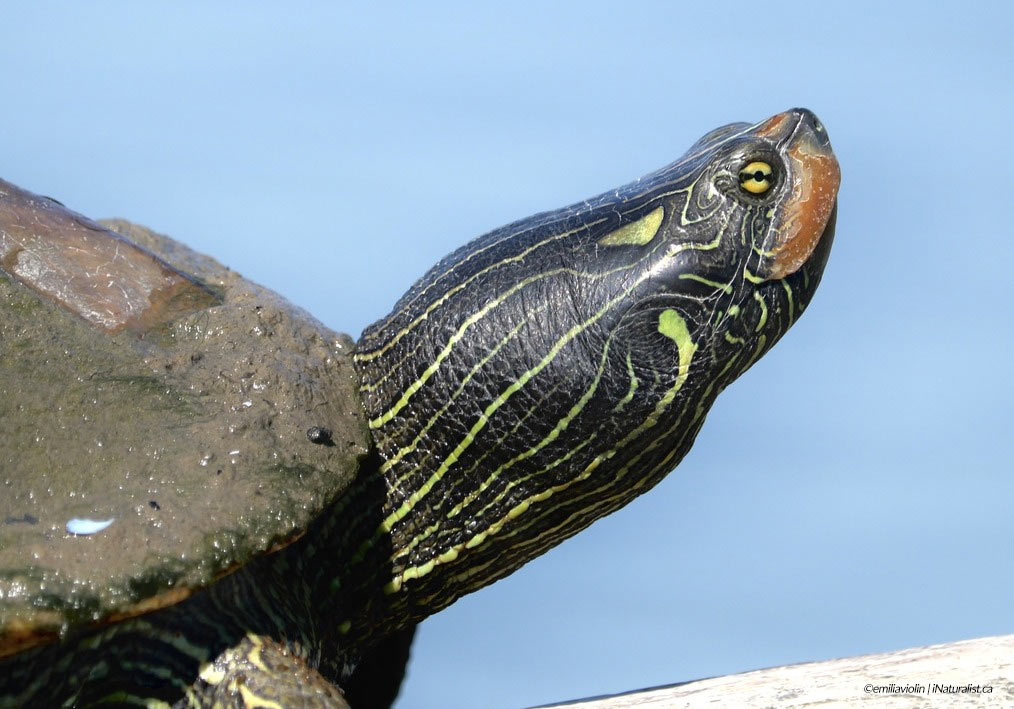
The native Northern Map Turtle has a round or triangular shaped blotch behind the eye. There is some variation between individuals, so this mark may sometimes be rather indistinct, but it is usually about the same size as the turtle’s eyes. The typical habitat of this species is large rivers and lakes but it can sometimes be found in smaller water bodies that connect to the typical habitat. This turtle is native to Central and Southern Ontario as well as a small portion of Southwestern Quebec. This is not to say this range only contains Northern Map Turtles as non-native species can appear anywhere. Map turtles found in Canada, outside of this area, were released by humans and thus non-native. Be mindful as well that a map turtle in an unusual habitat, such as an urban pond, was likely placed there and non-native.
False Map Turtle
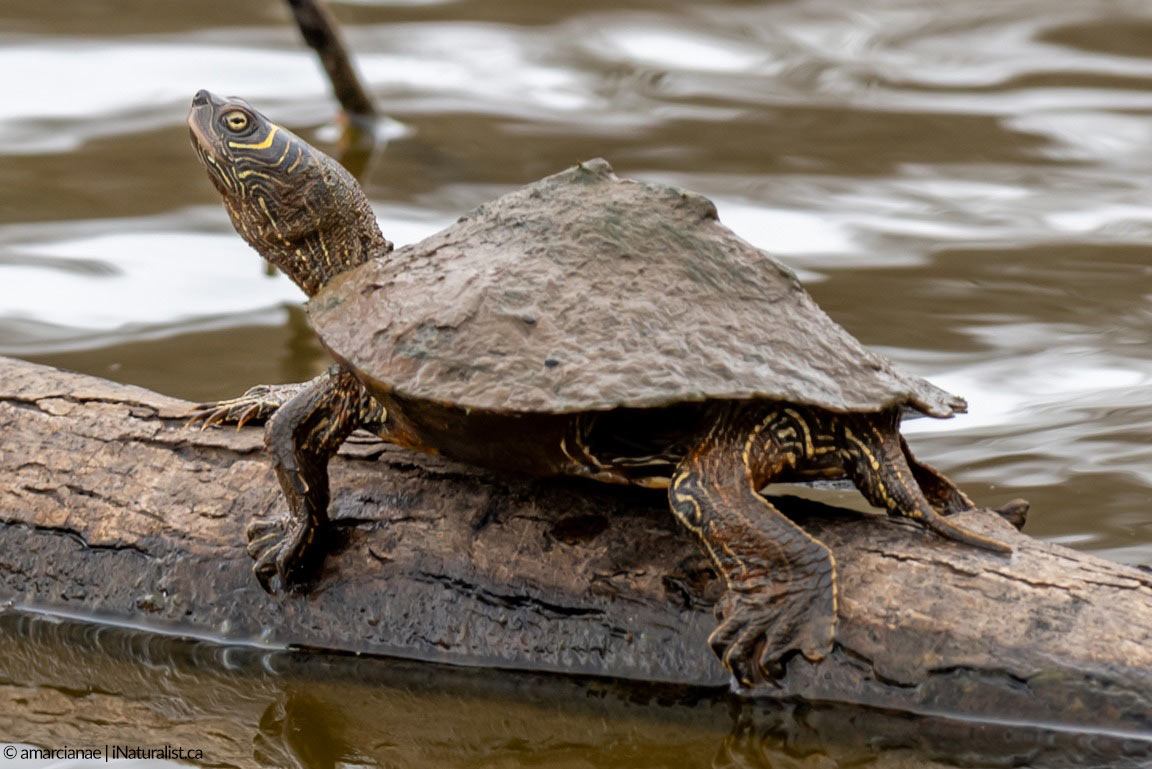
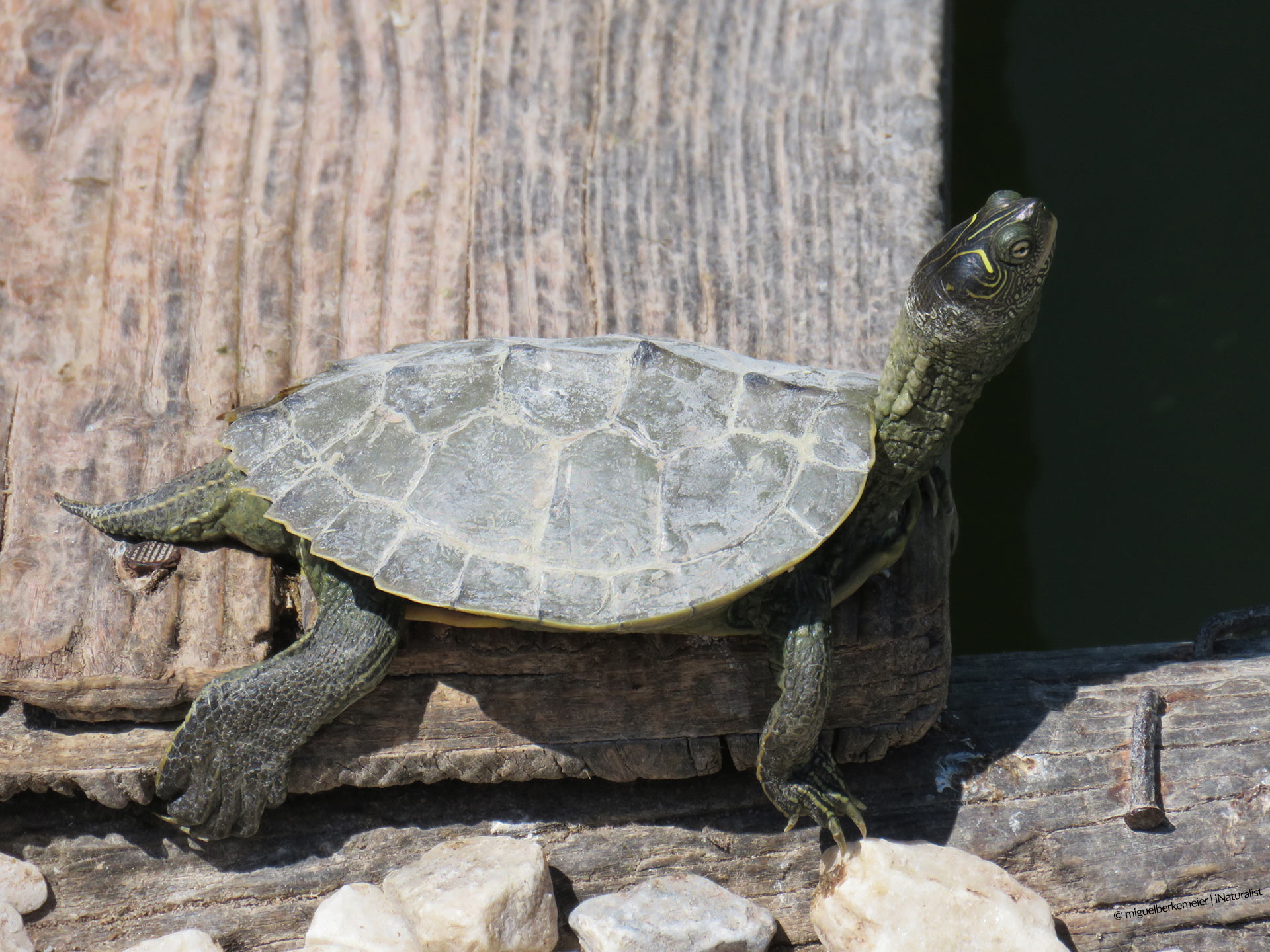
The False Map Turtle has two subspecies, with different patterns on the head. The Northern False Map Turtle has a thick line in an “L” shape behind the eye, colloquially referred to as a hockey stick or eyebrows. These lines are not fully visible unless photographed from above but are often distinctive enough in a profile photo to identify. In the second subspecies, the Mississippi Map Turtle, this mark is extended to curl around the eye towards the nose and mouth.
Ouachita Map Turtle
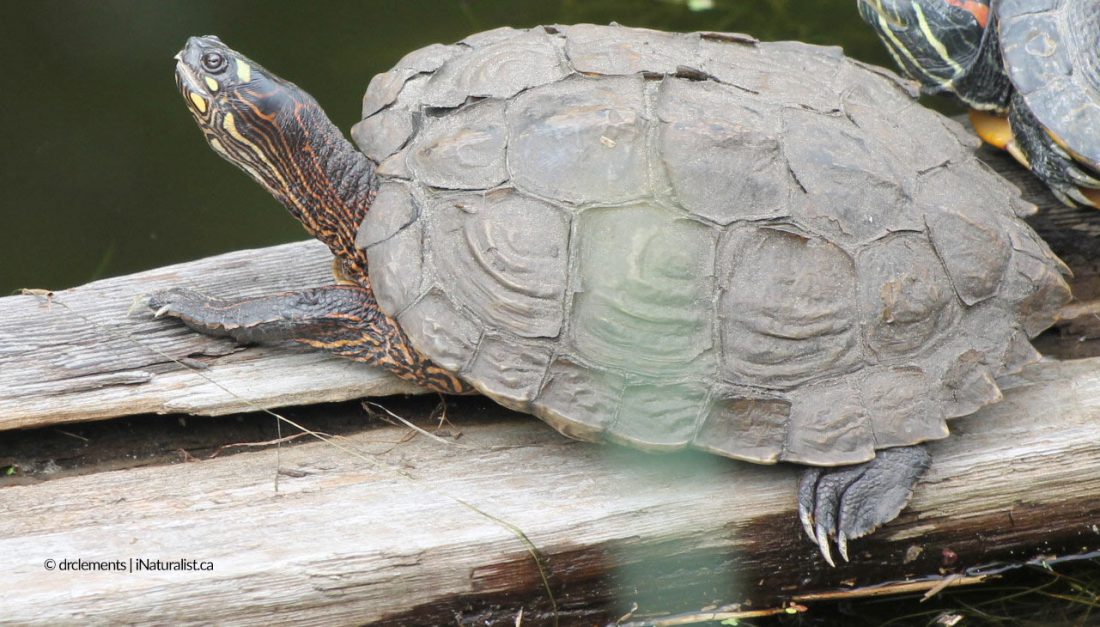
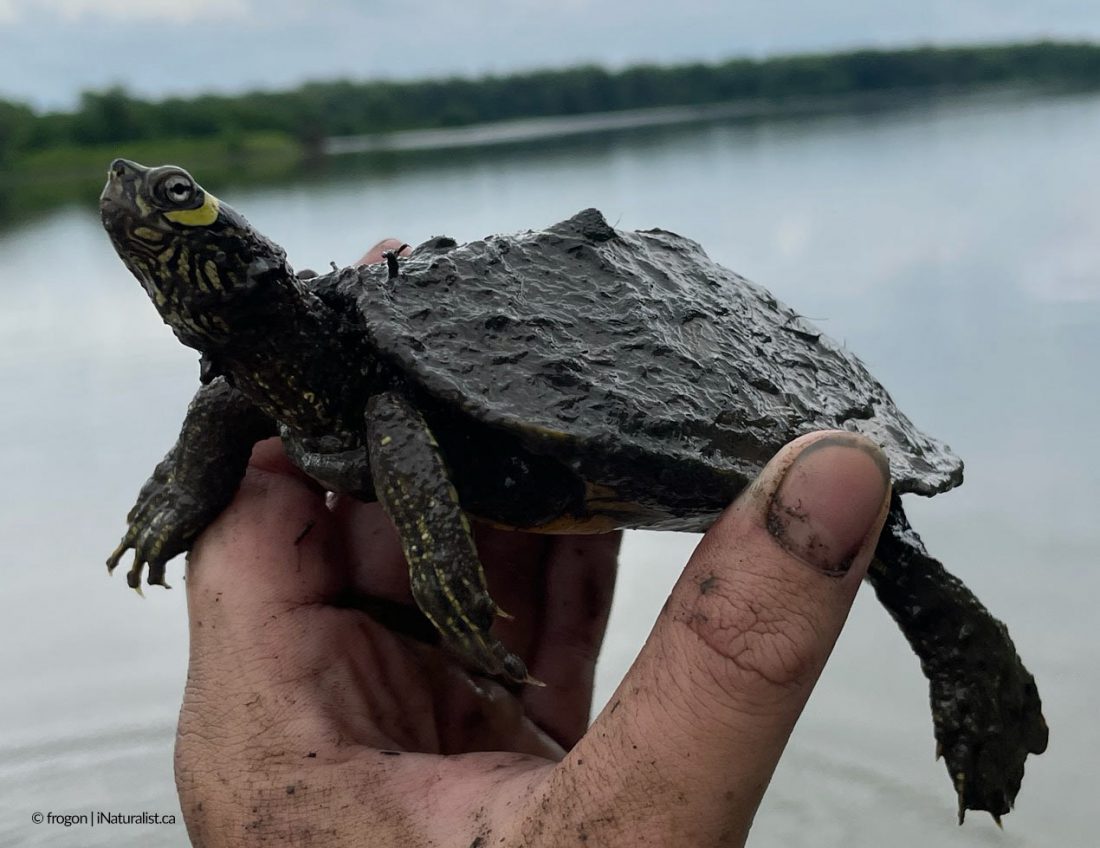
Finally, we have the Ouachita Map Turtle. This species probably has the most variance in patterning and can look similar to either False Map Turtle subspecies. The mark behind the eye on this species is typically rectangular in shape and is much larger than the turtle’s eye. The definitive feature of this species is actually a spot on the lower jaw almost directly below the eye. On the Ouachita Map Turtle this spot will be at least as wide as the turtle’s eye.
This is a lot of information. Even for the turtle experts at the Canadian Wildlife Federation, identifying map turtles is a challenging undertaking. When you are uploading observations to iNaturalist Canada, if you think it is a non-native species but not certain, take your best guess. While it can be confusing to properly identify map turtle species, it is more important that the observation is flagged as non-native than for the identification to be perfect.
The next time see a map turtle in the wild, pause for a moment and double check the head patterns. You may have just spotted a stealthy invader.

Mackenzie Burns
Mackenzie Burns graduated from the Marine and Freshwater Biology Program at the University of Guelph. She began working with CWF's turtle team in 2018.