Last month, we focused on connecting with our outdoor spaces by slowing down, observing and building a relationship with the natural world around us.
This month, we take the next step in the WILD Spaces journey: Learn.
Once you’ve connected with a space, curiosity naturally follows. Who lives here? What plants are growing? Why are some areas buzzing with insects while others seem quiet? What role does this space play in supporting wildlife?
Learning about your WILD Space helps students move beyond observation and begin understanding the relationships that make ecosystems work.
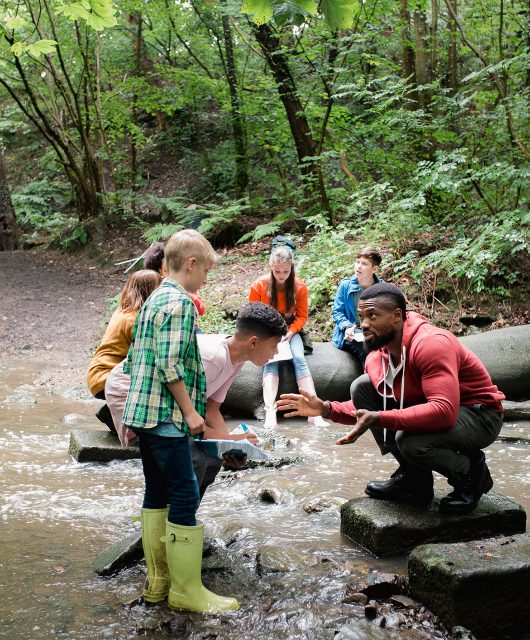
Become Nature Detectives
The best way to learn about a WILD Space is to ask questions.
Encourage students to investigate:
- What species of plants are growing here?
- Which birds visit throughout the day or season?
- Are there pollinators present?
- What signs of mammals can be found?
- Are there areas that provide food, water or shelter for wildlife?
- How does this space change throughout the year?
Students don’t need to know all the answers. In fact, the questions are often the most important part.
By investigating their schoolyard or community, students begin to see it as a living ecosystem rather than simply a place they pass through.
Tools to Help You Learn
Fortunately, there are many excellent resources available to support your investigations.
- Canadian Centre for Nature-based Education — This online centre is a wealth of knowledge and resources, from the Nature Near Me map to the large list of partners who offer nature-based education all across the country. Find something near you.
- Hinterland Who’s Who — One of Canada’s most trusted wildlife resources, Hinterland Who’s Who offers species profiles, videos and factsheets about the animals that live in our forests, grasslands, wetlands and communities.
- iNaturalist Canada — Become a community scientist! iNaturalist Canada allows students to record observations and receive help identifying plants, animals, fungi and insects.
- CWF Encyclopedias — Look up the plants you find in the Native Plant Encyclopedia. Maybe you’ll find out it’s actually a harmful invasive plant listed in the Invasive Species Encyclopedia.
- Birds Canada — Learn about Birds Canada’s work to protect the birds we love and discover the practical steps you can take to help! Download the Merlin Bird ID app to listen to the birds in your WILD Space.
- Learning for a Sustainable Future — LSF can help you link your students’ learning to sustainability with high-quality classroom resources for all grades and subjects.
- EcoSchools Canada — Certify your school as an EcoSchool or subscribe to EcoSchools Canada’s newsletter for updates and announcements. Watch this inspiring story about an Eco School connecting with gardeners in their community.
- Lab 22 — Lab22 equips Québec school staff with more than 100 ready-to-use educational resources, offers a personalized three-year support program to high schools, and provides immersive experiences for young people to inspire a desire to engage in the socio-ecological transition.
- ReForest London — Even if you’re not located in London, Ontario, ReForest London offers excellent resources related to biodiversity, tree identification, invasive species and schoolyard greening.
Learn Through Observation
One of the simplest learning activities is also one of the most effective.
In September, we chose a Sit Spot in your WILD Space. Revisit this spot regularly throughout the seasons.
Ask students to record:
- species observed
- weather conditions
- flowering plants
- signs of wildlife
- changes in habitat conditions
Over time, these observations reveal patterns and help students understand how ecosystems change seasonally.
You may even discover wildlife using your space that you never noticed before.
Learn It. Share It.
Our overall theme this school year is Conservation Actions. November’s action theme is Social Action: raising awareness and inspiring others to care about wildlife and the environment.
One of the best ways to deepen learning is to share it. Once students have investigated the plants, animals and habitats in their WILD Space, encourage them to teach others what they’ve discovered. They might create posters, fact sheets, presentations, social media posts, announcements or displays for other classes.
By sharing knowledge, students help build a community that understands and values nature. After all, learning doesn’t end when we discover something new; it grows when we pass that knowledge on to others.
A November Learning Challenge
Create a class “Who Lives Here?” board and share your discoveries with others.
Choose five species that have been observed in your WILD Space and challenge students to investigate:
- What does it eat?
- What habitat does it need?
- What role does it play in the ecosystem?
- How can we help it thrive?
Students can create fact cards, drawings, posters or digital presentations and share them with other classes. Check out this example of a flash card game where you have to match the pollinator to the plant. Flash card activity details.
Want more ideas for student-led awareness campaigns and communication projects? Check out this month’s WILD Education blog on Social Actions.

CWF-FCF
Our mission is to conserve and inspire the conservation of Canada’s wildlife and habitats for the use and enjoyment of all.