
To protect endangered species we also need to protect the habitat they rely upon.
That’s a pretty basic idea. To protect a forest bird, we need to protect the forest – and not just the tree where she builds her nest. And to protect a Blanding’s Turtle, we need to protect the wetlands she depends upon – not just a log that she basks on.
Unfortunately, the Ontario government has decided to reduce habitat protection for threatened and endangered species in Ontario. Under the Endangered Species Act, one well documented observation of a Blanding’s Turtle would protect wetlands up to two kilometers from where the turtle was observed. Earlier this year the Ontario government repealed the Endangered Species Act and replaced it with the much weaker Species Conservation Act. The new act will protect the “dwelling place” of threatened and endangered species. What is a dwelling place? Based on the draft guidelines, it appears that for a Blanding’s Turtle a dwelling place will be no more than a single wetland.
On the Move
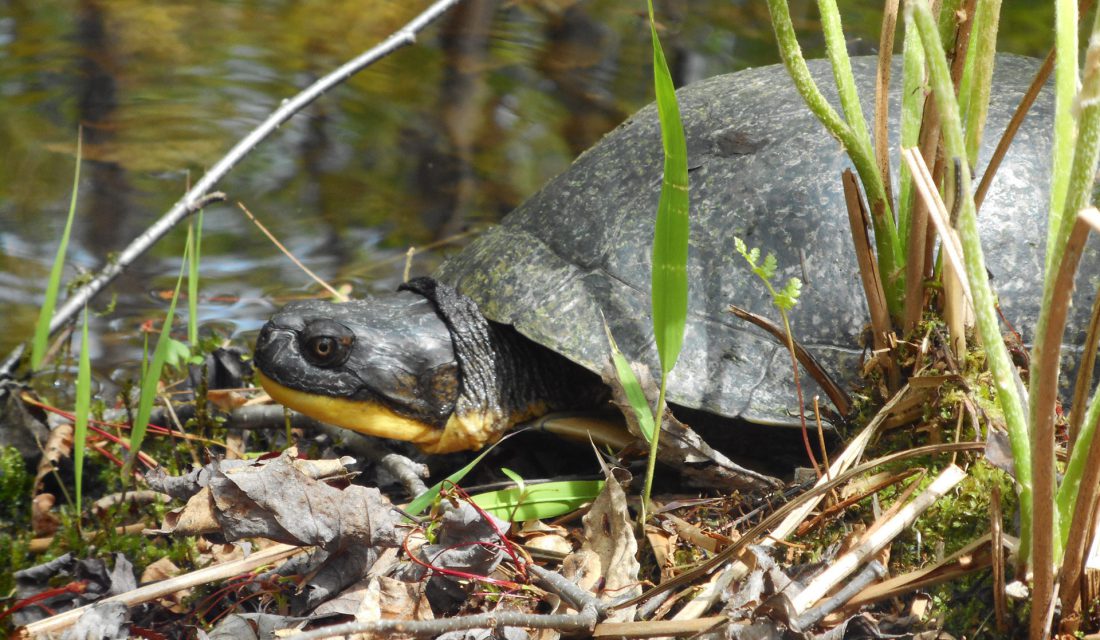
Isn’t that good enough? Isn’t protecting wetlands two kilometres from where a Blanding’s Turtle was seen unreasonable? Surely Blanding’s Turtles don’t wander that far. In fact, Blanding’s Turtles are very mobile and they make use of a variety of habitats over the course of the spring and summer. One study from Algonquin Provincial Park in Ontario found that some turtles tracked using radio transmitters moved more than two kilometres and one female moved six kilometres! Another study in Massachusetts tracked a Blanding’s Turtle that moved over three kilometres and many others moved over one kilometre. I have radio-tracked Blanding’s Turtles and have seen these kinds of movements for myself. One adult female I tracked moved further than one and a half kilometres.
Blanding’s Turtles don’t just move for fun, they need to move. A shallow wetland in spring might warm up faster and be good for feeding. If that wetland dries up, they may move to a deeper wetland. As the summer progresses they may move from one wetland to another like a diner at a buffet restaurant sampling the different food areas. And come late fall, the turtles will move to another wetland to spend the winter. One wetland is not enough! A study in Maine found that a Blanding’s Turtle could make use of up to 20 different wetlands over the course of the active season!
Much Less Protection for Ontario’s At-risk Turtles
Given that amount of movement and the number of wetlands that can be used, protecting one wetland is not enough. How does this play out on the ground? Since 2017, the CWF turtle team has been surveying for Blanding’s Turtles to find them in previously undocumented areas. We knew that each point on the map could protect numerous wetlands for Blanding’s Turtles and all the other species that depend upon those waterbodies. Now that protection is greatly reduced.
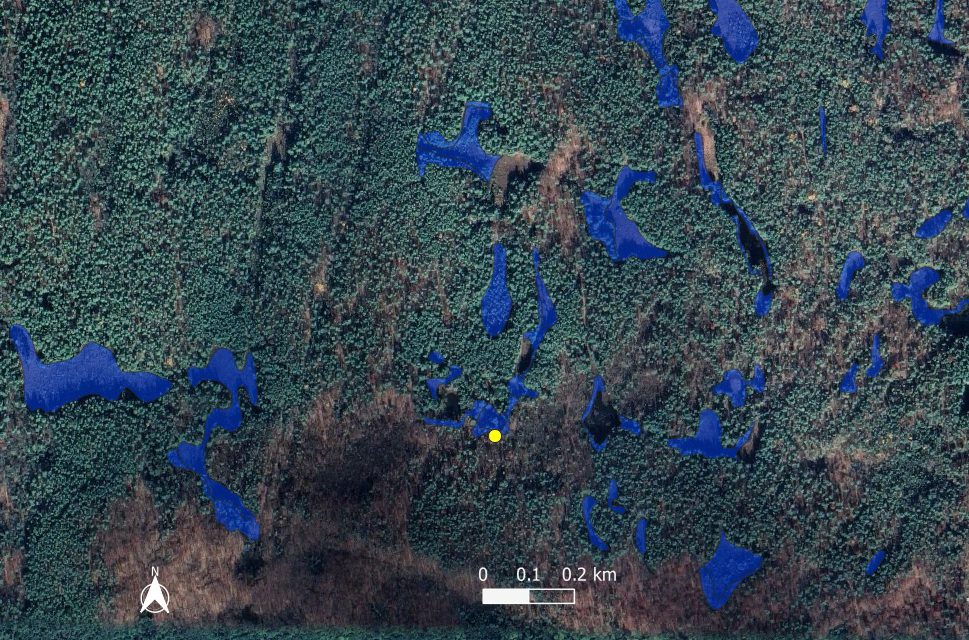
Look at the aerial image in this blog. The yellow point represents where we observed a Blanding’s Turtle in a wetland. The blue patches are wetlands as defined by the Ontario government. Under the old Endangered Species Act all of the wetlands in the image would be protected by that one observation of the Blanding’s Turtle. In fact, even more wetlands would be protected as the image just shows wetlands roughly 1 km from the Blanding’s Turtle observation. Under the new Species Conservation Act only the small blue patch where we saw the turtle would be protected. We would have to find and document a Blanding’s Turtle in each of the other wetlands to protect them as well.
How You Can Help
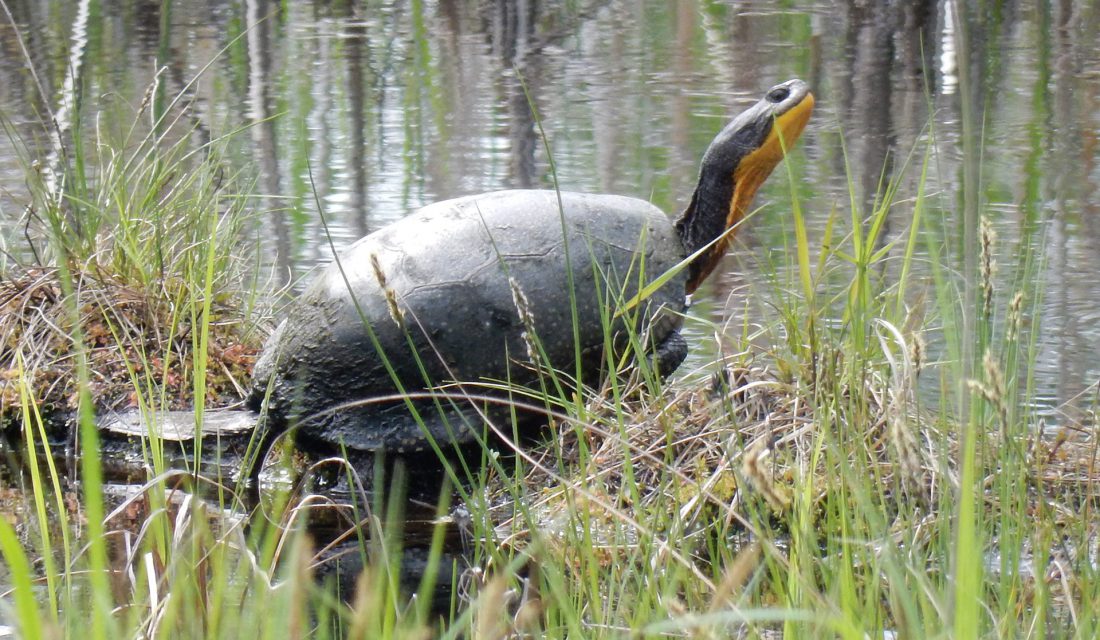
What can we do about the lack of habitat protection for our threatened and endangered species? Write your Member of Provincial Parliament. Tell them we need more habitat protection for these species. And if you see a Blanding’s Turtle please take a clear photo of it and post it to iNaturalist.ca. It may protect another wetland.

David Seburn
David Seburn is the Freshwater Turtle Specialist with the Canadian Wildlife Federation. David has worked on amphibian and reptile conservation for more than 25 years. He has radio-tracked turtles through swamps and spoken to hundreds of people about turtle conservation. In 2020, he was presented with the Blue Racer Award from the Canadian Herpetological Society for significant contribution to the conservation of Canadian amphibians and reptiles.


3 comments
Hi
I believe I had a blanked turtle at my cottage.
If you want people to contact a member of Parliament it would help if you prepared at least a pro forma letter that we could just download and send. Better yet, automatic send via your website, like many other organizations do.
Regards,
Hazel Elmslie
London, ON
Thanks for your comment! The time period for public consultation on the removal of the Endangered Species Act to replace it with the much weaker Species Conservation Act ended back in May. Although it is always valuable to let the government know of your concern for the well being of Canada’s wildlife. When the consultation was open, CWF did rally to encourage people to respond and provided background info and wording that could be used in a past blog, in our newsletter, through social media and direct email the content of which can be found here: Ontario Scrapping the Endangered Species Act: What You Can Do About It – Your Connection to Wildlife. CWF also submitted our own thorough comments expressing a strong opposition to scrapping the Endangered Species Act.