Mitreworts are delightful woodland plants in the Saxifrage family.
Canada has two species, Naked Mitrewort (Mitella nuda) and Two-leaved Mitrewort (Mitella diphylla), both of which are also called Bishop’s Cap, depending on who you talk to. There were others in this genus but thanks to reclassifications, they are now members of other genera. [Note: Genus and genera are the scientific words for the group(s) of plants within a family.]
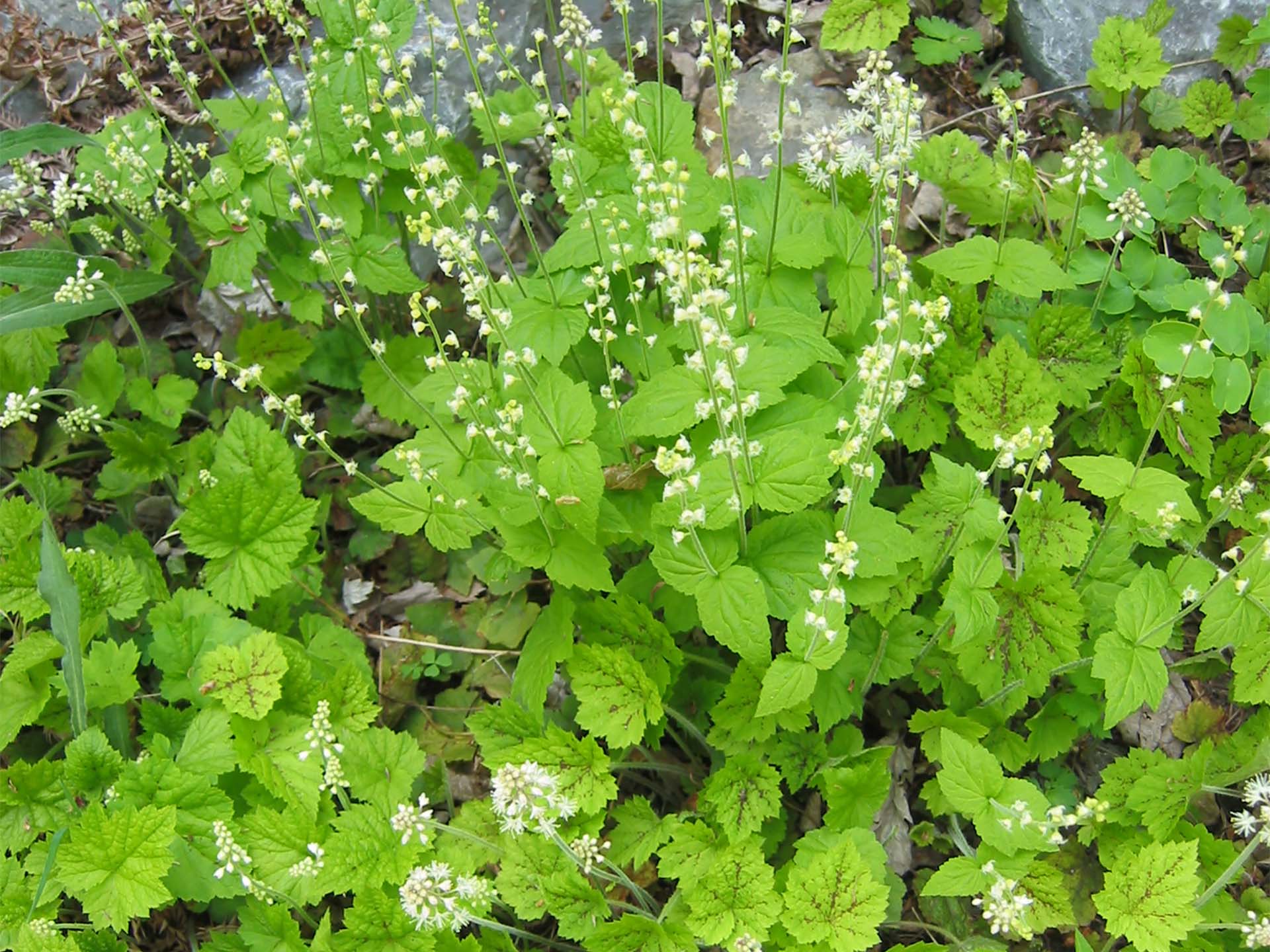
While Two-leaved Mitrewort is native to Ontario and Quebec, Naked Mitrewort can be found in all provinces and territories, although its current presence in Nunavut is uncertain. Both grow in rich woodland and forest environments amid moss, rotting logs and other woodland wildflowers. They can also grow along streambanks, with Naked Mitrewort found in wetlands such as swamps and bogs.
Naked Mitrewort forms low mounds with rounded heart-shaped leaves that have soft wavy edges. Exquisite, but ever so tiny, greenish off-white flowers form along a slender stem that rises above the leaves, with a height that can reach up to 20 cm tall.
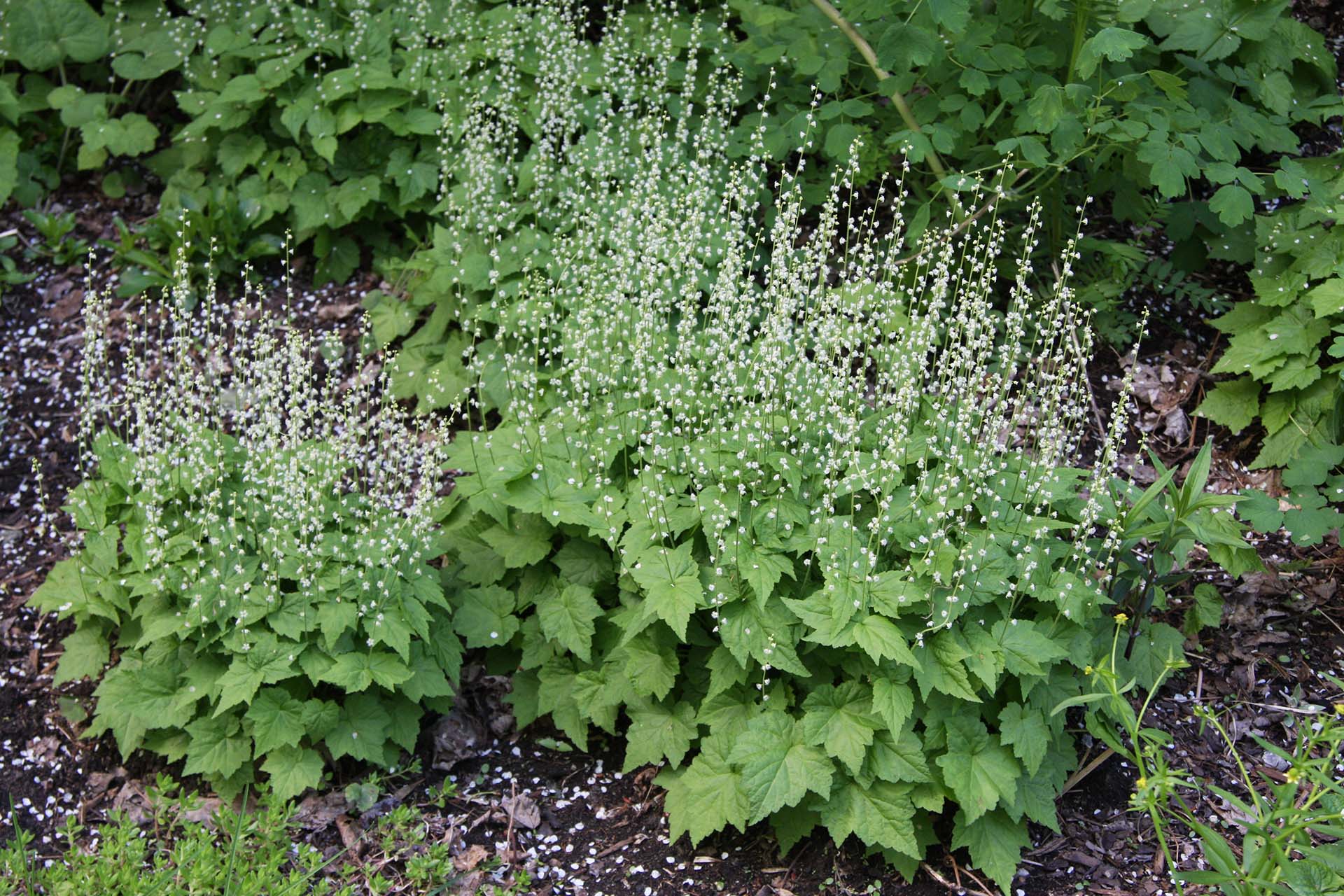
Two-leaved Mitrewort, on the other hand, is similar but the leaves are taller, have sharper edges and can resemble maple leaves. It also has a pair of stalk-less leaves along its flowering stems, hence its names ‘Two-leaved’ and ‘diphylla’ which is Greek for ‘two leaves’. Its cousin is called ‘Naked’ or ‘nuda’ as its flowering stalks lack this set of leaves. Two-leaved Mitrewort flowers are just as remarkable as its cousins’ but are white and highly reminiscent of delicate snowflakes. This plant can grow to approximately 50 cm tall and has sometimes been confused with another woodland plant, Heart-leaved Foamflower (Tiarella cordifolia), which grows in similar habitats and has similar-looking leaves. While their flowers are both white and bloom in spring along a stem that rises above the leaves, Heart-leaved Foamflower blossoms are as its name implies, like a foam, with flowers close enough together to give a frothy appearance when you stand back from the plant. If, however, you happen upon one of these plants when not in bloom, have a look at the hairs on the basal leaf stems. According to one iNaturalist.ca user, Two-leaved Mitrewort hairs grow at a 45-degree angle while those of the Heart-leaved Foamflower grow straight out from the stem, at a 90-degree angle, and of differing lengths.
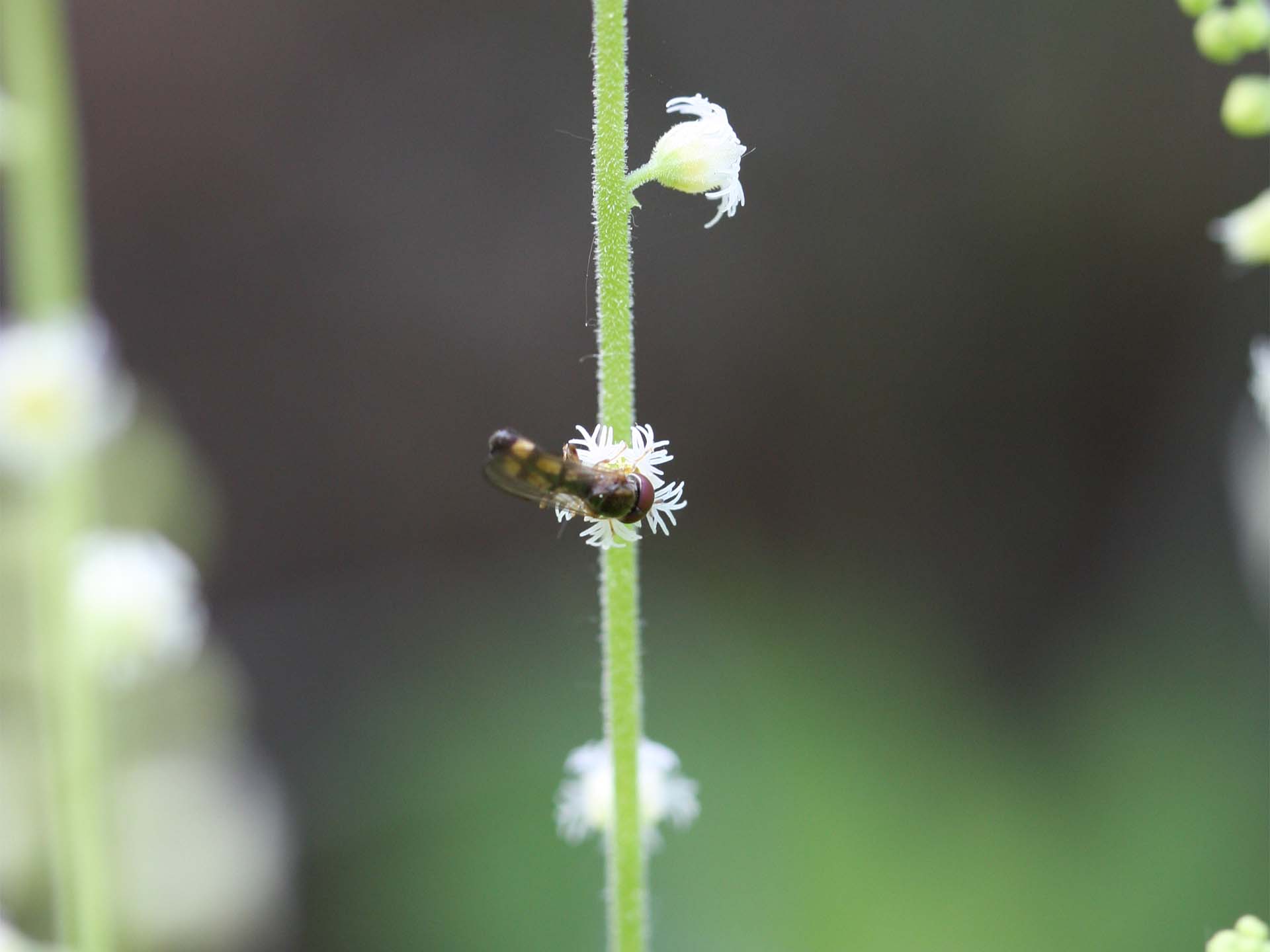
Both miterwort plants bloom anywhere from April to June, depending on where you are in the country. They are pollinated by flies such as mosquitoes, fungus gnats (in moist forested environments) and flower flies (also called hover flies but more scientifically known as syrphid flies). Mitrewort flowers also provide pollen and nectar for small solitary bees. Mitrewort has also been important to humans, as Indigenous Peoples have used it to treat sore eyes, earaches and fevers and as an emetic.
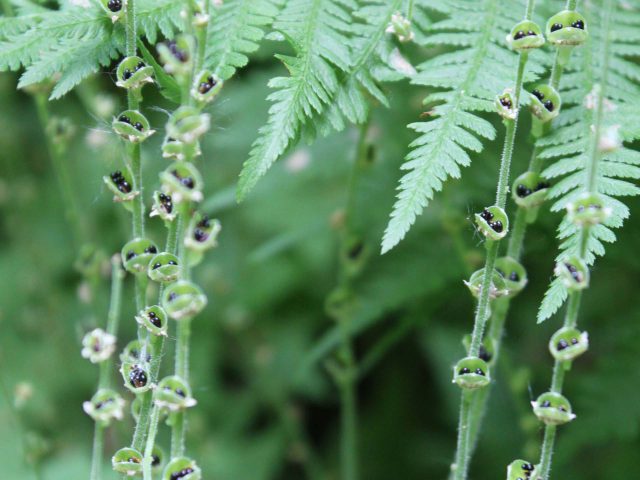
Once pollinated, tiny black shiny seeds form in a capsule that opens up fully with Naked Mitrewort. Two-leaved Miterwort is truer to its name as its seed capsule remains cup-like, resembling a ceremonial headdress worn by high-ranking clergy like bishops, called a miter. This is also how it got its other common name, Bishop’s Cap.
Gardeners can enjoy these plants by growing them in a damp shaded or partially shaded area. Two-leaved Mitrewort will often manage in drier spots, however, especially if the soil is rich with aged manure or compost. Having a light layer of fallen tree leaves around it can also help retain moisture and return nutrients to the soil. Mitrewort can grow well with other woodland plants that bloom around the same time, such as native geraniums and foamflowers, as well as ferns and mosses native to the area.

Sarah Coulber
Sarah is an Education Specialist at the Canadian Wildlife Federation. She writes about the benefits and ‘how-to’s’ of wildlife-friendly gardening, coordinates content for the Gardening for Wildlife web section, co-manages the wildlife-friendly demonstration gardens at CWF headquarters and assists Canadians looking to achieve similar results with their own properties.